
Artificial intelligence is placing new demands on computing hardware. Large language models, generative AI applications, AI agents, scientific workloads, and advanced data analysis require enormous amounts of computing power. As these systems become more capable, the processors supporting them must also become faster, more efficient, and easier to scale.
NVIDIA’s Blackwell architecture is designed around this growing demand. The platform targets AI training and inference while also supporting high-performance computing and data-intensive workloads. NVIDIA says Blackwell GPUs contain 208 billion transistors and use two dies connected through a 10-terabytes-per-second chip-to-chip connection.
What Is NVIDIA Blackwell?
Blackwell is an NVIDIA GPU architecture developed for accelerated computing and modern AI workloads.
The architecture is used in products such as the B200 GPU and GB200 Grace Blackwell systems. NVIDIA also has Blackwell-based solutions designed for data centers, professional workstations, and other computing environments.
The main focus is helping organizations train and run increasingly complex AI models while improving performance and efficiency.
Why AI Needs More Computing Power
AI models have grown substantially in size and complexity. Training these models requires processing huge amounts of information, while running them for users can require significant computing resources.
Inference, which is the process of using a trained model to generate results, is becoming especially important as AI applications move into search, software development, business tools, customer service, robotics, and other areas.
Blackwell is designed to address both training and inference workloads.
The B200 GPU
The B200 is one of the major GPUs based on the Blackwell architecture.
It is designed for data-center AI workloads and can be combined with other components to create larger computing systems.
NVIDIA’s Blackwell architecture uses two dies within a unified GPU design. The company says these dies are connected by a 10 TB/s chip-to-chip interconnect, helping the components operate as a unified processor.
The Grace Blackwell Superchip
NVIDIA also combines Blackwell GPUs with its Grace CPU architecture.
The GB200 Grace Blackwell Superchip connects two Blackwell GPUs with a Grace CPU using a high-speed NVLink-C2C connection. NVIDIA says the connection provides 900 GB/s of bandwidth between the components.
This design allows the CPU and GPUs to work closely together for demanding AI workloads.
AI Training
Training an AI model involves processing large datasets and adjusting the model’s parameters over many calculations.
As models become larger, training can require thousands of GPUs working together.
Blackwell is designed to support this type of large-scale computing by combining high-performance GPU processing with fast communication between processors.
NVIDIA says Blackwell systems can provide substantial improvements in training performance compared with earlier-generation systems, although actual results depend on the model, software, system configuration, and workload.
AI Inference
Inference is increasingly important as AI services become part of everyday applications.
When someone asks an AI assistant a question, generates an image, uses an AI coding tool, or interacts with an AI-powered application, the underlying model must process the request and produce a response.
Blackwell is designed to accelerate these inference workloads, particularly when organizations need to serve large numbers of users.
The Transformer Engine
Modern generative AI models often rely on transformer architectures.
Blackwell includes a second-generation Transformer Engine designed to accelerate training and inference for large language models and mixture-of-experts models. NVIDIA says the technology combines Blackwell Tensor Cores with software technologies such as TensorRT-LLM and NeMo.
This hardware and software combination is important because AI performance depends on more than raw processor speed.
Lower-Precision AI Computing
AI workloads can sometimes use numerical formats that require less precision than traditional scientific calculations.
Blackwell introduces additional precision capabilities designed to improve the efficiency of AI workloads.
NVIDIA highlights FP4 and other microscaling techniques as part of its approach to running larger AI models efficiently while maintaining useful accuracy.
These technologies can help reduce the amount of computation and memory required for certain AI workloads.
High-Speed GPU Communication
Large AI systems require GPUs to communicate with each other quickly.
If processors spend too much time waiting for data, adding more GPUs does not necessarily provide proportional performance improvements.
NVIDIA’s NVLink technology is designed to provide high-bandwidth communication between GPUs.
In large Blackwell systems, this allows many GPUs to operate as part of a closely connected computing environment.
The GB200 NVL72
One of the clearest examples of Blackwell’s large-scale design is the GB200 NVL72.
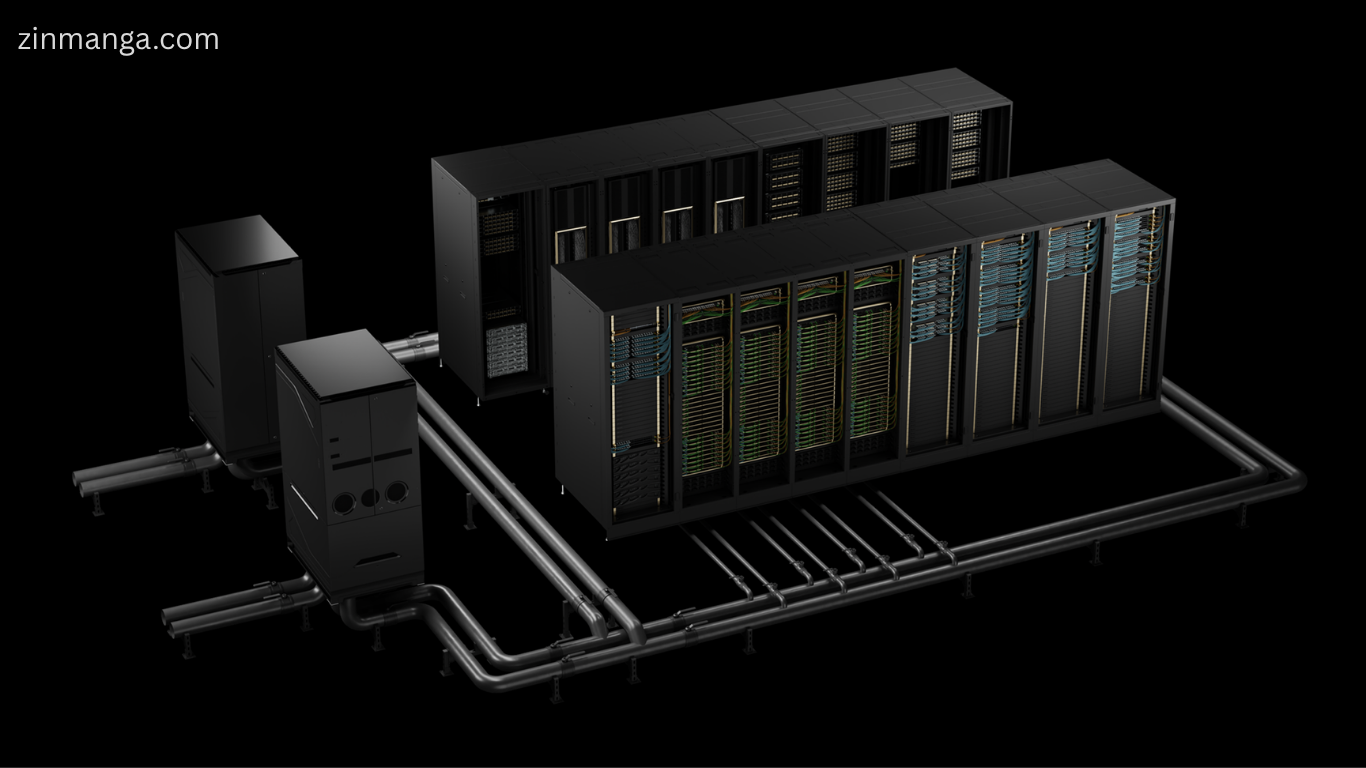
The system connects 36 Grace CPUs and 72 Blackwell GPUs in a liquid-cooled rack-scale configuration. NVIDIA describes the 72-GPU NVLink domain as operating like a single large GPU for demanding AI workloads.
This approach demonstrates how modern AI infrastructure is moving beyond individual accelerator cards toward complete computing systems.
Networking Matters
AI data centers need fast networking because large numbers of GPUs must exchange information during training and inference.
Blackwell systems can use high-speed networking and NVLink technologies to connect processors across servers and racks.
NVIDIA says the GB200 NVL72 provides up to 130 TB/s of GPU communication bandwidth within its NVLink domain.
Fast communication can be just as important as raw computing power when thousands of processors work together.
Energy Efficiency
AI computing consumes significant amounts of electricity, particularly when large models are trained or operated at scale.
Improving performance per unit of energy has therefore become an important goal for data-center operators.
NVIDIA says its GB200 NVL72 can deliver higher AI performance at a given power level compared with previous-generation H100 infrastructure. Such figures are based on specific configurations and workloads, so real-world results can vary.
Liquid Cooling
Powerful AI systems generate substantial heat.
Blackwell-based rack-scale systems such as GB200 NVL72 use liquid cooling to manage high-density computing.
Liquid cooling can allow data centers to place more computing power into a smaller physical area while managing the heat produced by the processors.
This is becoming increasingly important as AI infrastructure grows.
Large Language Models
Large language models can contain billions or even trillions of parameters.
Running these models efficiently requires large amounts of computing power and memory.
Blackwell systems are designed to support these increasingly large models through a combination of GPU performance, memory bandwidth, high-speed interconnects, and specialized AI processing.
Mixture-of-Experts Models
Some modern AI systems use mixture-of-experts architectures.
Instead of activating every part of a model for every request, these systems can route different tasks through selected sections of the model.
Blackwell’s Transformer Engine is designed to support mixture-of-experts workloads, making the architecture relevant to newer approaches to large-scale AI.
AI Data Centers Are Changing
Traditional data centers were designed around general-purpose computing.
Modern AI data centers increasingly look different. They require specialized accelerators, high-speed networking, advanced cooling, large memory systems, and software designed to coordinate thousands of processors.
Blackwell is part of this broader transformation.
Software Is a Major Part of the Platform
Hardware alone does not determine AI performance.
Software frameworks, libraries, drivers, compilers, model optimization tools, and inference systems all affect how effectively GPUs can be used.
NVIDIA’s Blackwell platform works with its broader software ecosystem, including technologies designed for AI training and inference.
Enterprise AI
Businesses are increasingly exploring AI for customer service, document analysis, software development, forecasting, data processing, and other applications.
Enterprise AI workloads can require reliable infrastructure capable of running models continuously.
Blackwell systems are designed to support these demanding workloads in data-center environments.
Scientific Computing
AI and traditional high-performance computing are increasingly overlapping.
Researchers use accelerated computing for areas such as scientific simulation, climate modeling, drug discovery, engineering, and other computational workloads.
Blackwell-based systems can support both AI and high-performance computing workloads, making the architecture relevant beyond generative AI.
Data Analytics
Blackwell architecture also includes technologies designed to accelerate certain data-processing workloads.
NVIDIA highlights a dedicated decompression engine and high-speed access to Grace CPU memory for database and data analytics applications.
This demonstrates how GPUs are increasingly being used for more than graphics and traditional AI calculations.
AI Agents
AI agents can perform multiple steps to complete a task rather than simply generating a single response.
These systems may need to reason, access information, use software tools, generate code, and review results.
As agentic AI becomes more sophisticated, the computing requirements for inference can increase significantly.
Blackwell’s focus on large-scale inference makes it relevant to this emerging category of AI applications.
Personal AI Computing
Blackwell technology is not limited entirely to massive data centers.
NVIDIA’s DGX Spark uses a GB10 Grace Blackwell Superchip and 128 GB of unified memory. NVIDIA says the system is designed to let developers and researchers work locally with AI models of up to 200 billion parameters.
This points toward a future in which increasingly capable AI workloads can be performed closer to individual developers and researchers.
Challenges of Blackwell Systems
Powerful AI hardware also creates challenges.
Large systems require significant investment in processors, networking, cooling, electricity, physical infrastructure, and software.
Organizations must consider the total cost of operating AI infrastructure rather than looking only at the performance of individual GPUs.
Availability, compatibility, energy requirements, and data-center capacity can also affect deployment decisions.
Competition in AI Hardware
NVIDIA is not the only company developing AI accelerators.
Other semiconductor companies and major technology firms are developing competing GPUs, AI accelerators, and custom chips.
This competition is pushing the industry toward faster processors, improved memory systems, better energy efficiency, and more specialized AI hardware.
The result is a rapidly changing market where hardware generations are evolving alongside AI models.
The Importance of Scalability
AI models are likely to continue growing, but not every organization needs thousands of GPUs.
A useful AI computing platform therefore needs to operate across different scales.
Blackwell products range from individual accelerators and workstations to large rack-scale systems.
This allows the architecture to address different types of users and workloads.
The Future of AI Computing
AI computing is moving toward larger models, more complex reasoning, real-time inference, and increasingly autonomous software systems.
These trends will place greater demands on processors and data centers.
Blackwell represents one approach to addressing these demands through a combination of GPU architecture, high-speed interconnects, memory technology, networking, cooling, and software.
Why Blackwell Matters
The importance of Blackwell extends beyond a single generation of NVIDIA GPUs.
It reflects a broader change in computing, where AI workloads are becoming central to data-center design.
Instead of treating AI as one application running on conventional infrastructure, companies are increasingly building entire computing environments around AI.
Frequently Asked Questions
What is NVIDIA Blackwell?
NVIDIA Blackwell is a GPU architecture designed for accelerated computing, artificial intelligence, and high-performance workloads. It powers products including the B200 GPU and Grace Blackwell systems.
What is the B200?
The B200 is a data-center GPU based on NVIDIA’s Blackwell architecture. It is designed for demanding AI training and inference workloads.
What is the GB200?
The GB200 is a Grace Blackwell superchip that combines two Blackwell GPUs with a Grace CPU through high-speed interconnect technology.
Why does AI need powerful GPUs?
AI training and inference involve large numbers of mathematical calculations. Powerful GPUs can process many of these calculations in parallel, making them useful for demanding AI workloads.
Is Blackwell only designed for AI?
No. Blackwell technology can also support high-performance computing, data analytics, scientific workloads, professional computing, and other accelerated applications.
Conclusion
NVIDIA Blackwell chips are part of a broader shift toward specialized infrastructure designed specifically for the growing demands of artificial intelligence. The architecture combines powerful GPUs with high-speed communication, advanced AI processing, large-scale networking, and systems designed for demanding data-center workloads.
Products such as the B200 and GB200 demonstrate how AI computing is moving from individual processors toward highly integrated systems capable of connecting large numbers of GPUs. NVIDIA is also extending Grace Blackwell technology into more compact computing platforms for developers and researchers.
